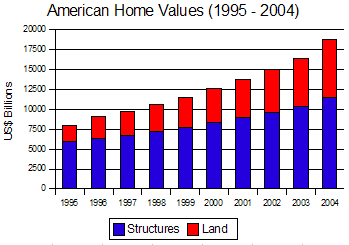
Over the decade 1995 - 2004, the market value of residential real estate increased, on average, about 10% a year. (See: Federal Reserve Flow of Funds Table B100.)

The same table shows that the replacement cost of America’s homes, rose, on average, only about 7.6% a year.

If these estimates are reasonably correct, we can deduce that the value of the land on which American homes are built increased, on average, about 15.6% a year, over the decade.

The graph, drawn from this data, shows how overall residential real estate values changed over the period 1995 - 2004.
American Homes: Land vs. Buildings

Over the decade, the imputed value of land as a percentage of total residential property values, rose from 25% to 38%. (Note: The imputed value of land is the market value of residential real estate less the cost of replacement of structures.)

Taking into consideration home equity values (market value less mortgages), land values increased from a 43% share to a 64% share, on average, of home equity values.

Since these figures represent averages for the entire nation, we may conclude that in some sections, land values are still around 20% of residential property values, whereas in other areas, land values may be higher than 60% of property values.

More »

 
divider

The sponsors of ‘defined benefits’ pension plans controlled, as of December 2004, about US$2.5 trillion in equities belonging, indirectly, to the beneficiaries of these plans.

(See: “Who’s Holding America’s Stock Proxies?“)

In December 2004, U.S. equities, even after the crash of 2000-2001, were still substantially over-valued.

(See: “Equity Values“)

In order for stock prices to reflect values that were customary for a century before the advent of stock buybacks, prices would have to drop between 20% (earnings basis) and 50% (dividend yield basis).

In the case of ‘defined benefits’ pension plans, this would represent a loss of between US$500 billion and US$1.2 trillion in market value of pension portfolios!

To put this in context, such an ‘adjustment’ would be equivalent to from 90% to 210% of before-tax corporate profits in 2004.

In another context, a fall in valuation to historical levels would be equivalent to from one- and to two-thirds of all receipts of state and local governments in 2004.

More »

divider

Over 55% of corporate stock that belongs to U.S. Households and Nonprofit Organizations is held indirectly through intermediaries who hold the power to vote these shares.

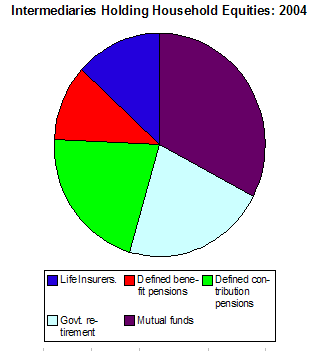
As of December 2004, according to the Federal Reserve Flow of Funds Account Table B100e, this indirect stock ownership was divided among five major categories of intermediaries, by market value:

  1. Life Insurance Companies: ($1,028.9 billion), as pension reserves, mainly individual and group annuities.
  2. Defined Benefit Private Pension Funds: ($859.9 billion), mainly corporate pension plans.
  3. Defined Contribution Pension Plans: ($1,656.3 billion), mainly 401(k) and similar company plans.
  4. State, Local, and Federal Government Retirement Funds: ($1,706.3 billion), mainly defined-benefit pension plans for state and local governments.
  5. Mutual Funds: ($2,531.6 billion), mainly as Individual Retirement Accounts.

The graphs shows how indirect holdings of equities belonging to Households and Nonprofit Organizations were divided among these categories of intermediaries in December 2004:

Intermediaries Holding Stock Proxies
 
divider

Sites we love

copyright | privacy | home

Powered by WordPress | Entries (RSS) | Comments (RSS)